
In our recent webinar, themed “Multi-Asset Investing in an accelerating world: trusting the process”, Stephen Backhouse, Head of Retail Strategy: Group Channels and Warren Buhai, Senior Portfolio Manager in the Multi-Asset team, discussed the team’s latest views, process and forward-looking market scenario probabilities.
Current market priorities
Market priorities have changed since the beginning of the year. The current preoccupation is not the US/Iran war, but dramatic moves in Asian equities, primarily AI stocks. For example, the price of South Korean semi-conductor company, SK Hynix, shares recently changing by 10-15% every few hours, on big volumes.
AI spending is important because of its impact on economic growth and inflation, and on earnings, not only of the AI hyperscale's but the beneficiaries of their massive data centre-related capital expenditure. AI has already boosted productivity: US productivity has grown by 2.5% a year since 2022 (when Chat GPT was launched) compared with 1-1.5% a year in previous years. However, the downside risk of AI capex is that demand for certain inputs, such as semiconductor chips, is feeding into higher inflation, which influences monetary policy decisions.
Latest US inflation data has been positive, with both the CPI and PPI below expectations. Kevin Warsh, the new US Federal Reserve (Fed) chair, has expressed the view that AI productivity will have disinflationary consequences. He has also previously criticised central bankers for generally being too involved in markets, questioning whether quantitative easing policies are inappropriately supporting markets.
As long as the Fed makes its policy stance clear, there is less risk in markets, but his decision to limit forward guidance and press conferences could also create more volatility.
The team’s different approach
Our Multi-Asset team takes a different view from their peers: they argue that markets often lead economies, more than economies lead markets nowadays. The reasons are that markets are forward-looking and price in real-time data, and they have become bigger than economies: the US equity market is valued at over $70 trillion, which is more than twice the size of US GDP. A 10% move in the market has a significant effect on household wealth, so it can affect consumer and business confidence, as well as spending and investment decisions.
The STANLIB Multi-Asset team uses six lenses to view what markets and data are telling them currently.
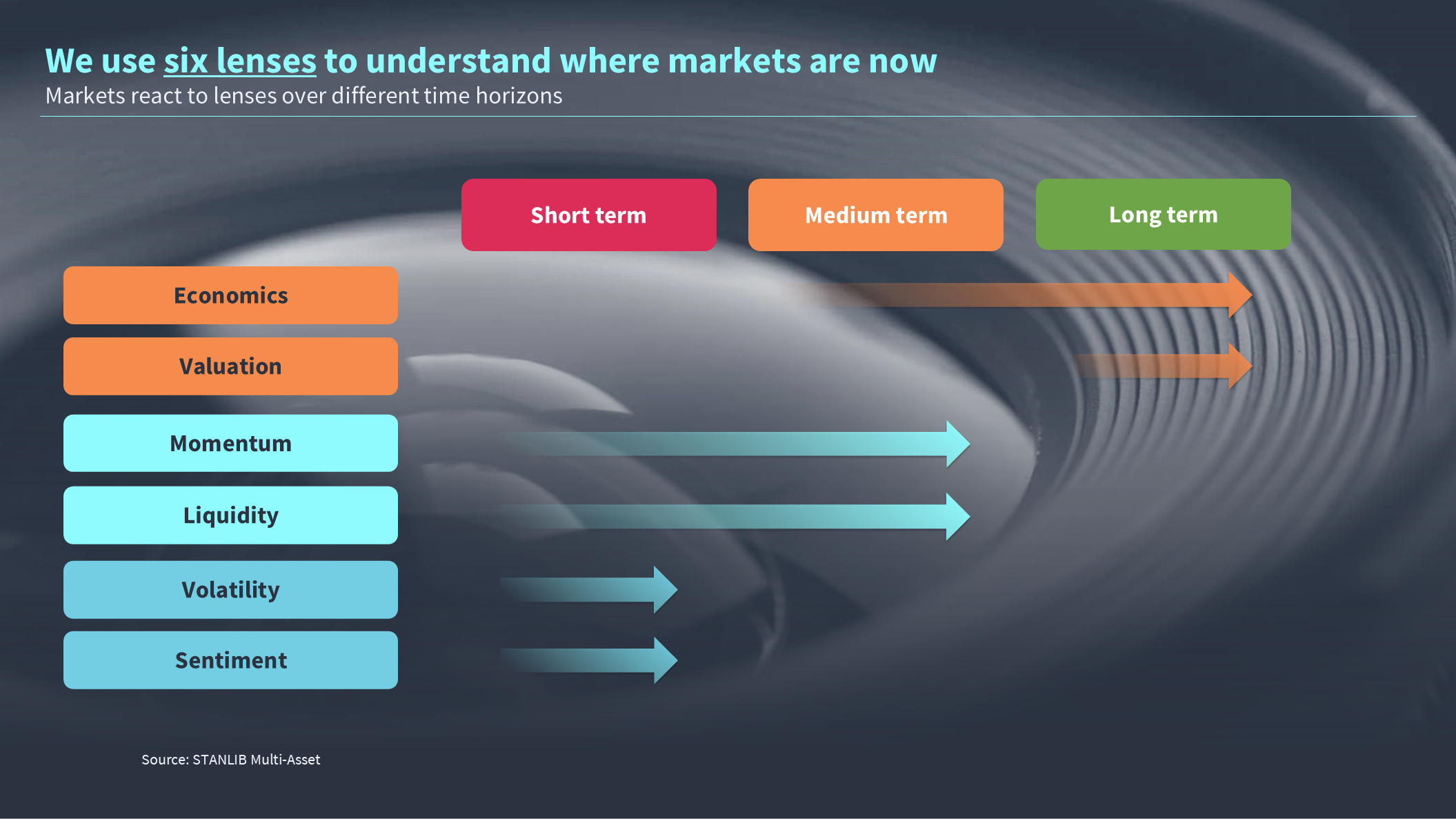
The first two lenses, economics and valuations, are traditionally how asset managers analyse asset prices, but tend to impact markets over the medium to long term. However, the Multi-Asset team also considers momentum, liquidity, volatility and sentiment.
Volatility and sentiment are short-term indicators that are more useful when at extreme levels, helping guide portfolio construction and the use of protection (upside or downside hedging).
Momentum and liquidity have become bigger drivers of market direction – over the short to medium term – than economics and valuations because of the larger size and faster speed of markets in modern times.
Momentum is being driven by AI euphoria, which is influencing not only the prices of the AI-related companies but also their earnings. Analysts’ forecasts are being regularly upgraded, because AI adoption is occurring faster than expected. Momentum is also accelerating as a result of the increase of passive investing, which interalia reflects retail demand for ETFs (especially in the US and South Korea) – and retail investors buy whatever theme is performing at the moment. As a result, equity markets are becoming more concentrated and risk is increasing.
However, despite recent dramatic moves in South Korean tech shares over the past six weeks, largely driven by retail demand, the AI theme is still intact. The Taiwanese market, which is similarly dominated by AI-related shares, has been flat over the same period.
Liquidity relates to both the availability and the cost of money. In a world where markets are bigger than economies, a lot of growth is financed by credit, which is sensitive to interest rates. The availability and cost of money, which central banks and governments can influence through monetary or fiscal policy, respectively, is critical.
In the past six months, market views have switched from expecting interest rate cuts before the US/Iran war, to pricing in one or two interest rate hikes – over the next 6-12 months – to contain inflation. However, that expectation is no longer necessarily negative for asset prices because data is showing that underlying economic growth remains resilient and company earnings have continued to surprise to the upside.
In their weekly meetings the team votes independently on their views on each of these six lenses, which can influence the actions taken in their portfolios.
Current market scenario probabilities
In conjunction with formulating lens views, the team also uses forward-looking market scenarios to assist with tactical asset allocation decision-making.
Attend-June, the team’s two bearish scenarios for the next six to nine months (Hard Landing or All Fall Down) were given a 40% probability, while the two bullish scenarios (Blow Off Top and Goldilocks) had a 60% probability.
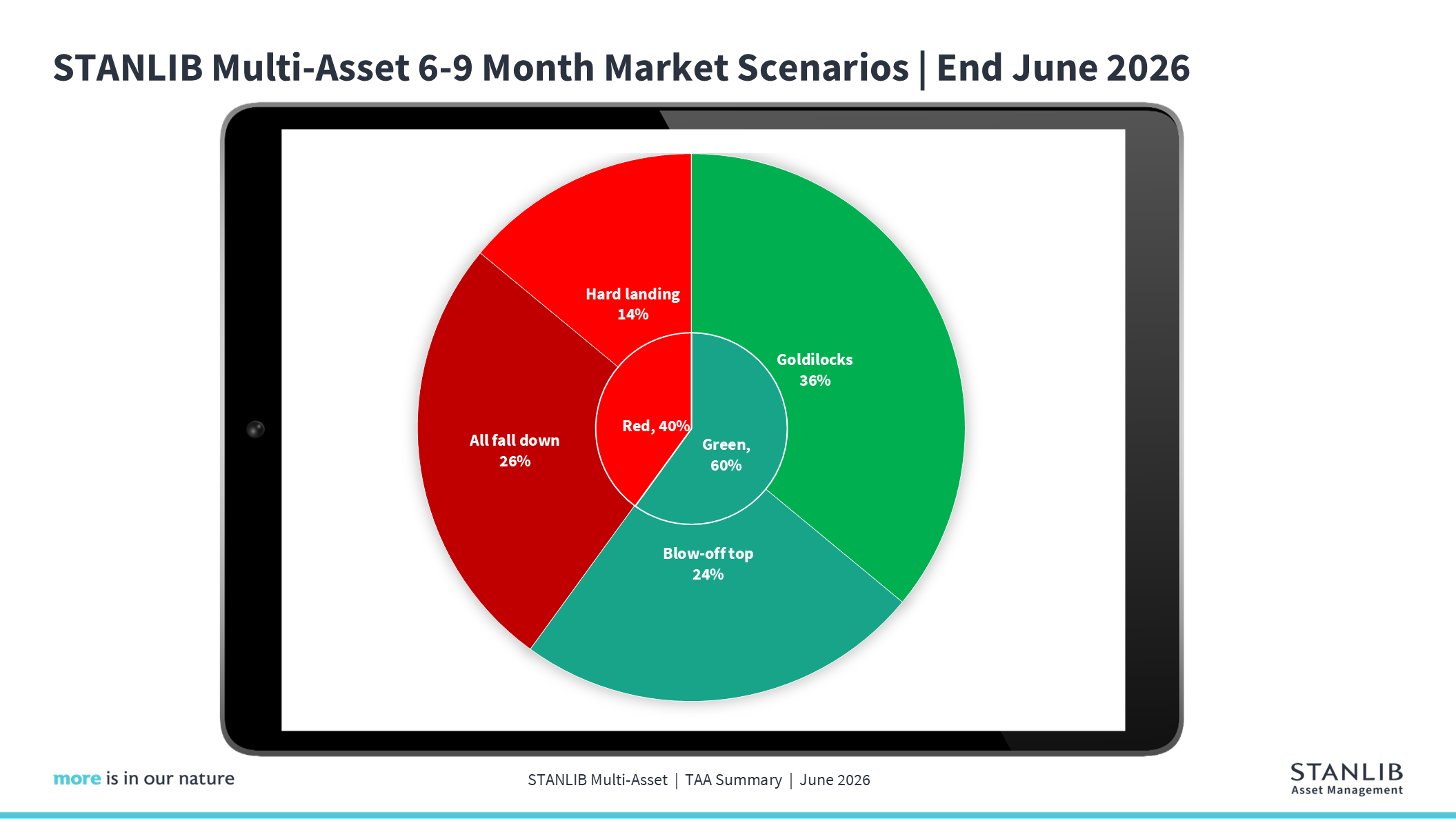
In Hard Landing, equities correct but developed market government bonds stay positive, acting as a diversifier. In All Fall Down, both equities and bonds correct. All Fall Down is rated as a slightly higher probability than Hard Landing because the risk of a recession, especially in the US, is not perceived as high, but AI-related demand could put pressure on inflation and potentially hurting both bonds and equities, similar to the 2022 experience.
The Goldilocks scenario currently represents over one-third of all probabilities: a broadening out of the bull market away from the dominant AI theme in which the laggards, including the South African equity market, start to perform again.
Current asset class views
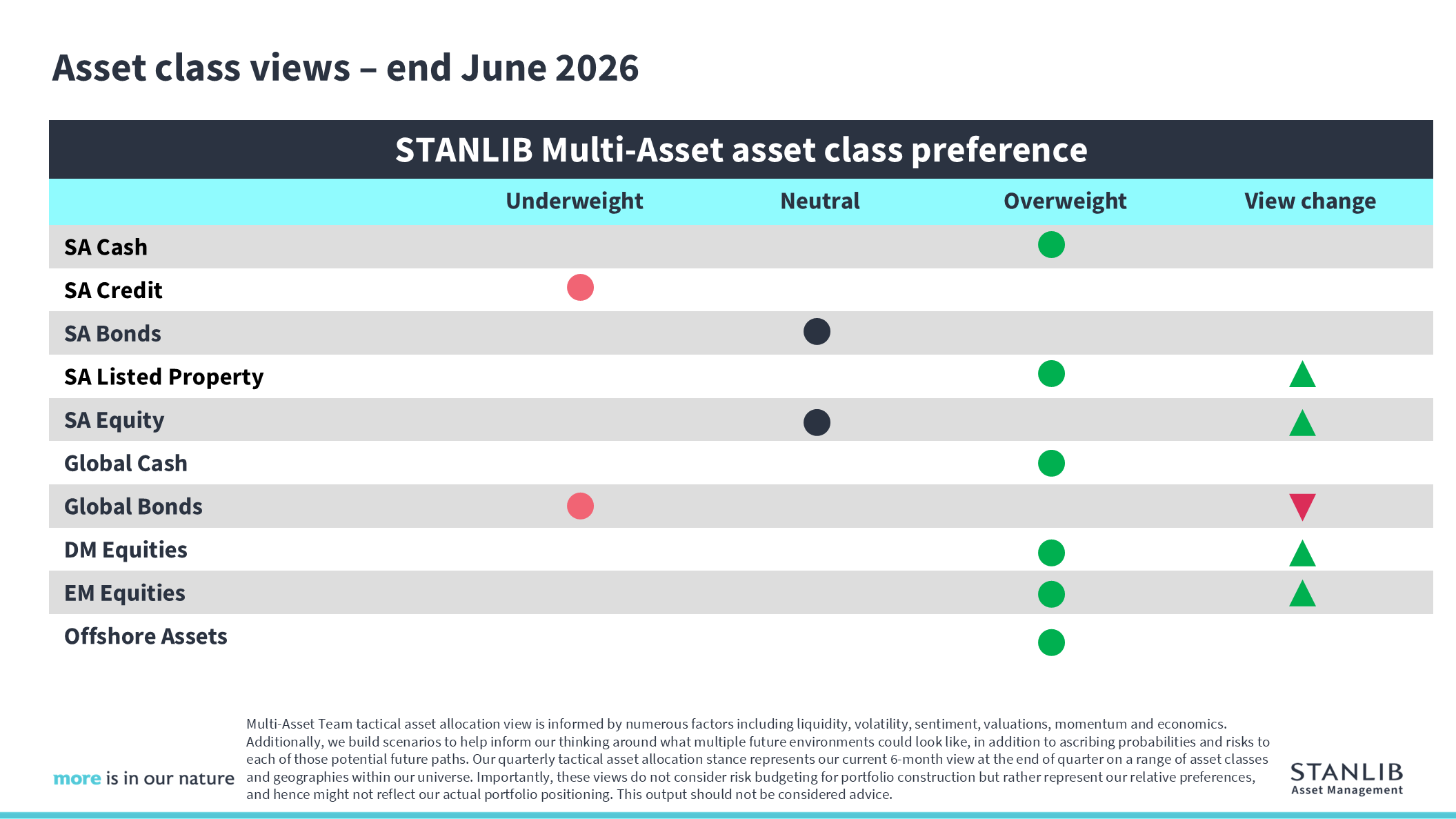
- The Multi-Asset team is currently more positive on offshore than domestic equities.
- They are neutral towards domestic equities and bonds.
- Domestic bond yields have fallen significantly but real yields remain high, so they are still relatively attractive.
- However, global bonds are a concern because of short-term inflation and excessive fiscal policy risks.
To protect the portfolio against the possibility of geopolitical upheavals, has broadened exposure to cheaper assets with good fundamentals and added protection where it is cheaper and appropriate to do so.
In summary, the team regards the global growth cycle as intact: in the US, growth is still near or above trend and inflation is contained. However, the path has become narrower, reflecting market concentration.
The AI theme, which is driving markets, shows no sign of receding and will likely continue to benefit assets in different ways, although there will also be losers. Importantly, there are positive fundamentals in the equity market, and forward-looking earnings indicators remain very strong. However, as is always the case this far into an equity bull market, and given the known unknown risks around AI, monetary policy and geopolitics, the team remains hyper aware that markets can change quickly.